Motor de Plasma.
PlasmaThrust-1 — Microwave Air-Breathing Plasma Engine (Isometric)
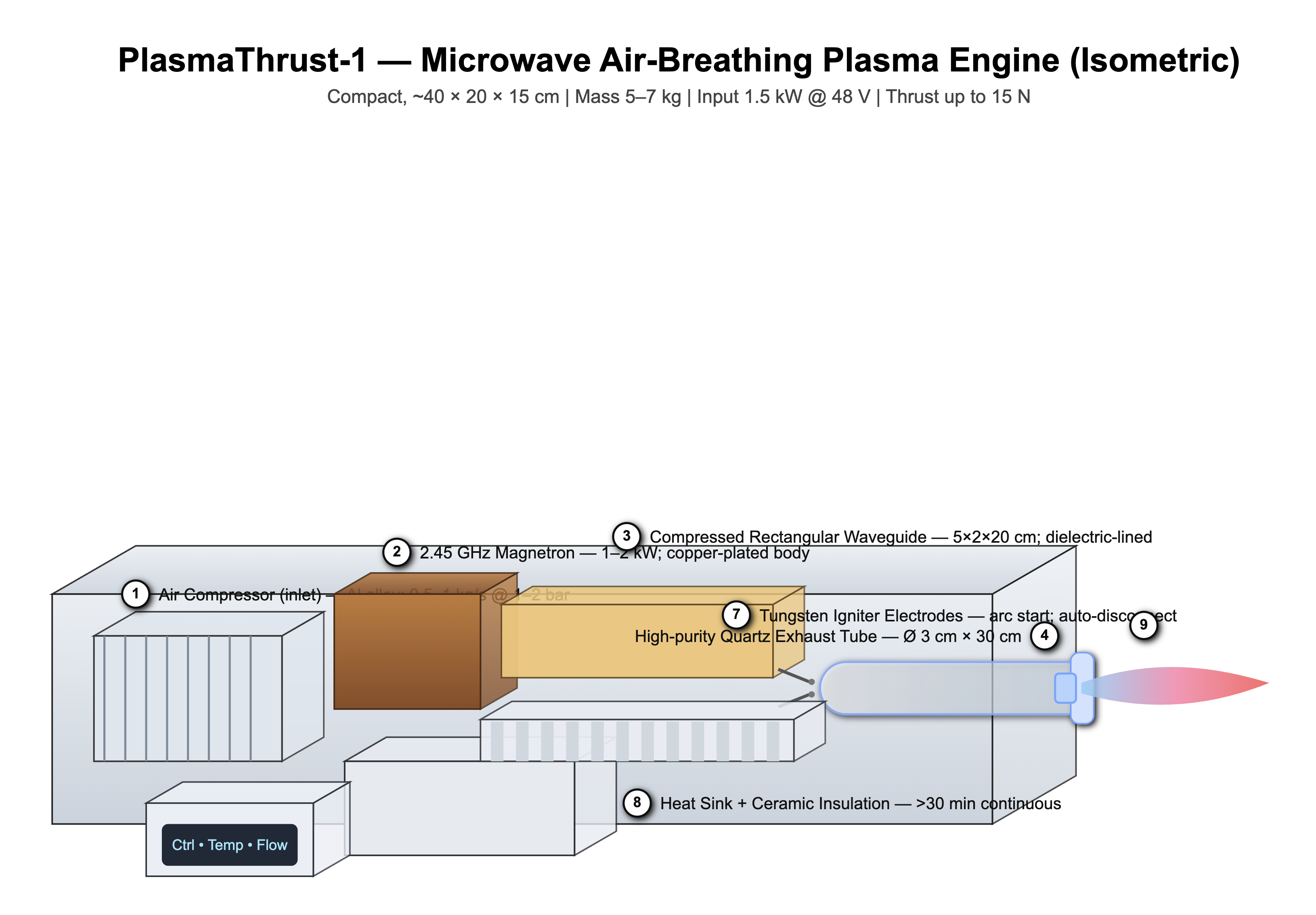
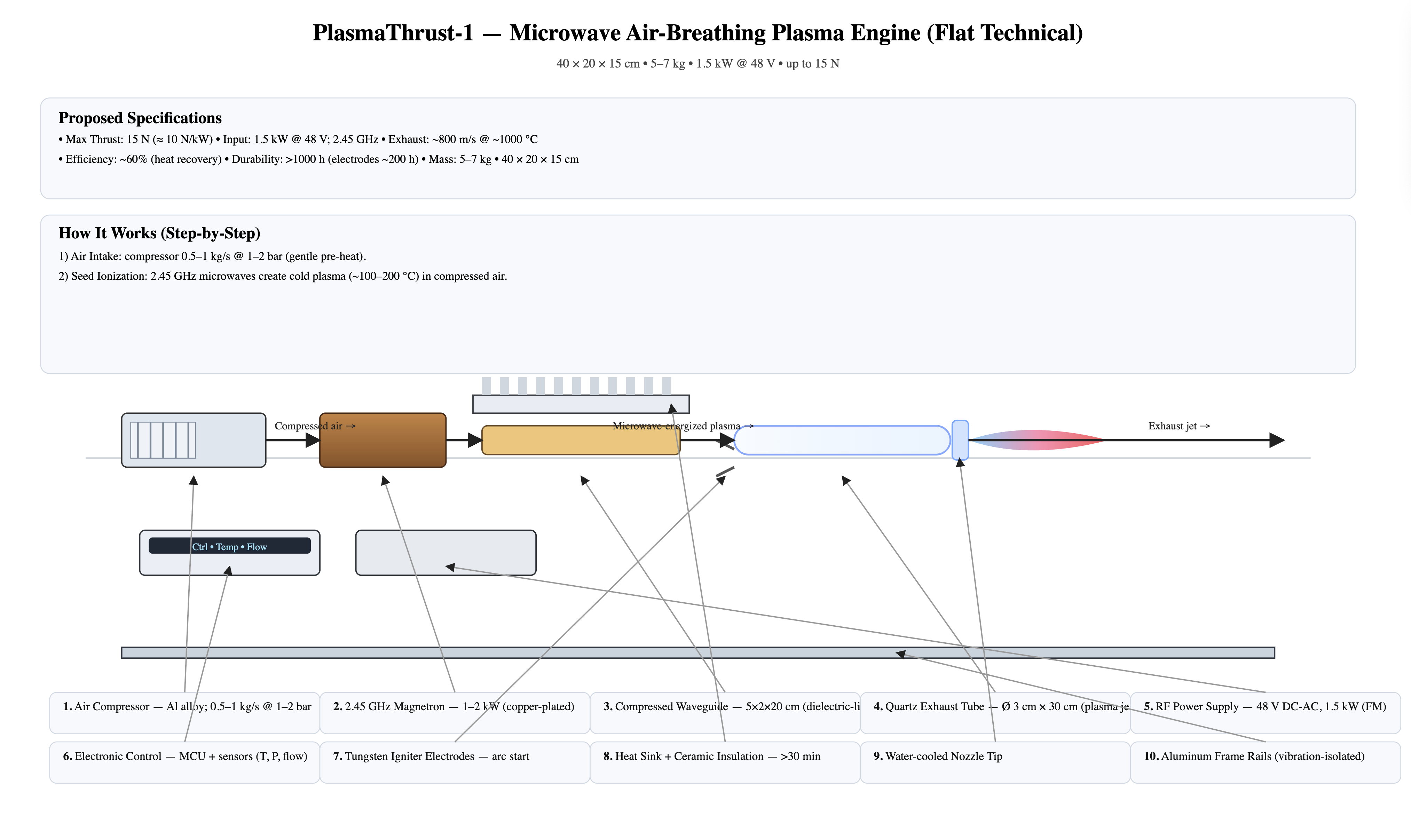
Key Components (numbered on the diagram)
-
Air Compressor (inlet) — Lightweight Al alloy centrifugal stage; 0.5–1 kg/s @ 1–2 bar
-
2.45 GHz Magnetron — 1–2 kW copper-plated body; microwave source
-
Compressed Rectangular Waveguide — 5 × 2 × 20 cm, dielectric-lined; field concentration
-
Quartz Exhaust Tube — Ø 3 cm × 30 cm, high-purity quartz; plasma containment
-
RF Power Supply (48 V DC-AC) — 1.5 kW with frequency modulation
-
Electronic Control (MCU + sensors) — Temp/pressure/flow; real-time control
-
Tungsten Igniter Electrodes — Arc start; auto-disconnect after stable plasma
-
Heat Sink + Ceramic Insulation — Fins + ceramics; continuous > 30 min
-
Water-cooled Nozzle Tip — Safety & durability at ~1000 °C exhaust
-
Aluminum Frame Rails — Vibration-isolated mounting
How it works (isometric flow)
-
Air intake: Compressor provides 0.5–1 kg/s at 1–2 bar.
-
Seed ionization: Magnetron injects 2.45 GHz power to form cold plasma (?100–200 °C).
-
Heating & acceleration: Flattened waveguide concentrates EM field; collisions raise temperature toward ~1000 °C.
-
Arc assist: Tungsten electrodes trigger ignition, then disconnect once plasma is self-sustaining.
-
Expansion & thrust: Pressurized plasma expands through the quartz tube/nozzle, producing a jet (~Mach 1–2).
-
Control loop: MCU modulates RF power and monitors T/P/flow to stabilize thrust and prevent overheat.
Proposed specifications
-
Max thrust: ~15 N (? 10 N/kW)
-
Input power: 1.5 kW @ 48 V; 2.45 GHz
-
Exhaust velocity: ~800 m/s
-
Exhaust temperature: ~1000 °C (cooled tip)
-
System efficiency: ~60% (with heat recovery for pre-heat)
-
Durability: > 1000 h (electrode service ~200 h)
-
Mass & envelope: 5–7 kg; 40 × 20 × 15 cm
Notes
-
The PNG shows a true isometric-style layout with callouts, flow arrows, a color-graded plasma plume, and a scale bar (0–40 cm).
